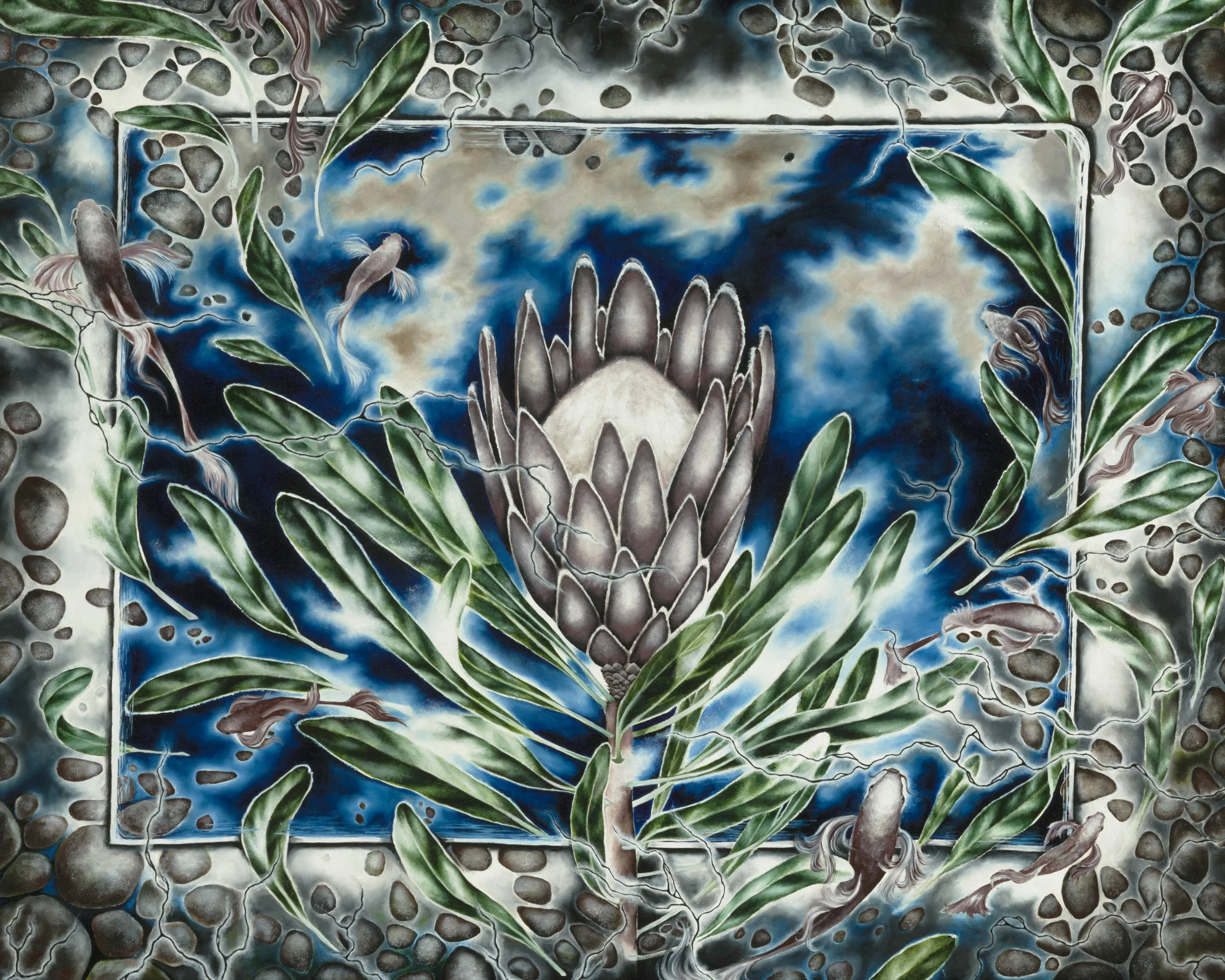
Dissipation
16”x20” Oil on Wood Panel
This painting is a striking blend of earthly and aquatic elements, creating a surreal landscape where the protea and koi coexist. Taken together they portray sustained beauty through change. A state of flow is depicted, where the strength of the protea and the determination of the koi work together in harmony in the vast deep blue water. The outer border of smooth river stones grounds the piece, representing patience and the passage of time.
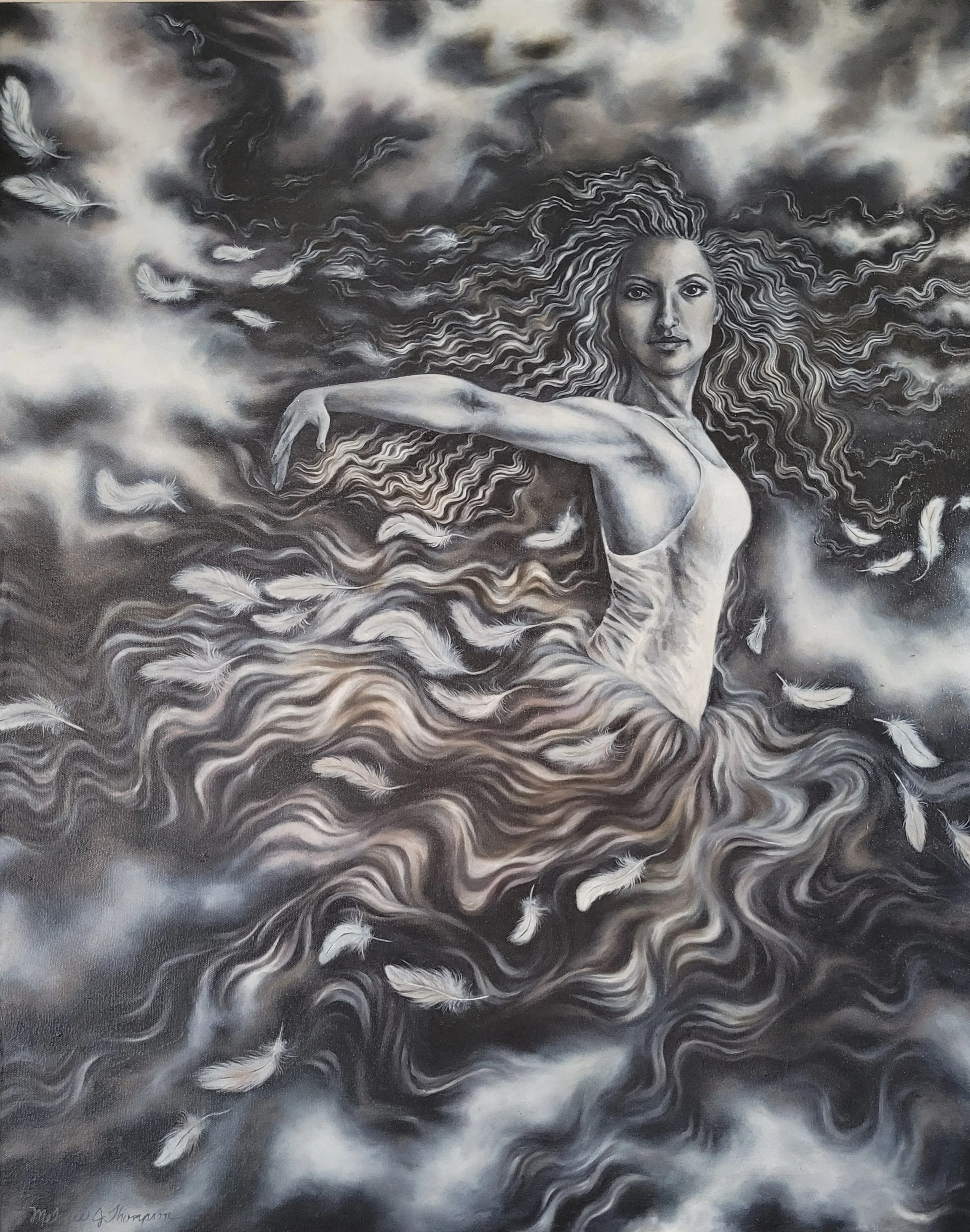
Resurrection
20”x30” Oil on Canvas
What began as an unexpected wound became an opportunity for transformation. During a wildfire evacuation, this painting’s surface was scratched, leaving behind damage that threatened to interrupt its story. Rather than allowing the painting to be defined by what had happened to it, I chose to breathe new life into the work, carefully restoring and reimagining its surface. In the process, the painting became something more than it had been before—a testament to resilience, renewal, and the unexpected beauty that can emerge from adversity. Like the figure moving through turbulent waves of darkness and light, the painting itself found a way to rise again.
The feathers scattered throughout the composition were added with a special significance: symbols of freedom, spiritual awakening, and the ability to lift ourselves above the weight of difficult experiences. Emerging from the swirling darkness, they suggest that even when life leaves its marks upon us, we are never without the possibility of renewal. Each feather becomes a reminder that lightness can be found again, that beauty can be reclaimed, and that we can rise beyond the circumstances that once threatened to hold us down. Sometimes resurrection isn't about returning to what we were, but discovering the strength and beauty of what we can become.
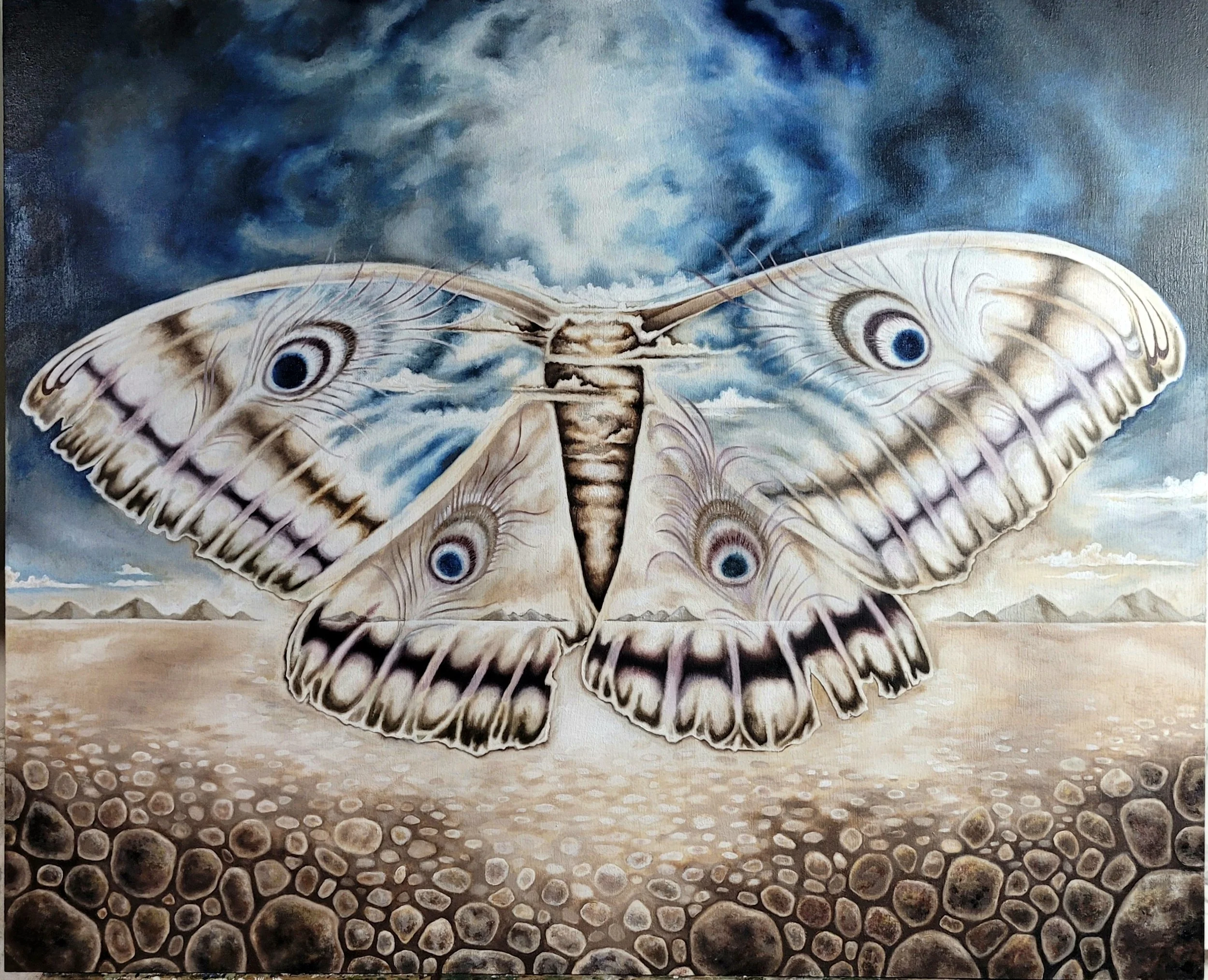
Desert Sonata
16” x 20” Oil on Cradled Wood Panel
This painting is a rich tapestry of surrealist motifs that plays with perspective, transformation, and the bridge between the celestial and the terrestrial. It suggests a profound interconnectedness between the individual soul and the universe.
The moth here is framed as a doorway between the waking world and a dream state. As the moth emerges from the terrestrial foreground, its wings symbolize metamorphosis, while the stones below represent the material realm. The sky takes on the role of enlightenment.
The eyes of the feathers, overlapping the eyes of the wings, are a gateway between the inner subconscious and the external world. They symbolize perception, knowledge, and the soul, and in this painting, the observation of a higher power during the moth's journey.
The overall mood is one that provokes contemplative reverence. Ultimately, the mood is balanced. There is a harmony between the motifs that portrays a peaceful emergence, showing that the transition of the moth — or "soul" — from a grounded existence to a soaring, transcendental one is a natural and peaceful occurrence.
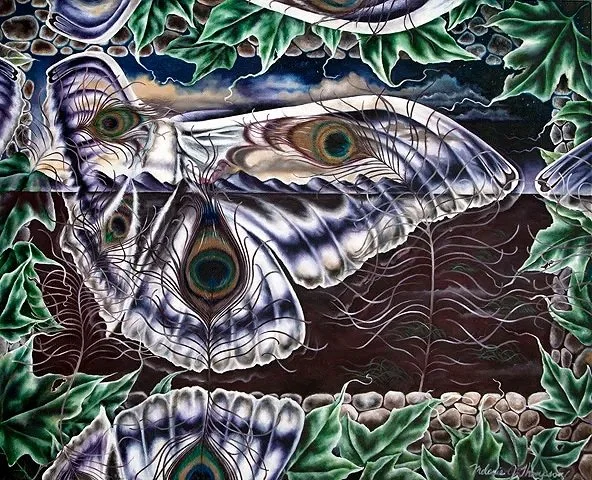
Daylight reveals the world as we know it, but night has a way of revealing something altogether different. As the familiar fades into shadow, our perception shifts, and the boundaries between reality, reflection, and imagination begin to dissolve.
In The Night Vision, the iridescent eyes of the peacock feathers become more than ornamental patterns. They seem to awaken in the darkness, quietly observing, reflecting, and perhaps even seeing beyond the limits of ordinary vision. Long associated with watchfulness, immortality, renewal, and spiritual awareness, the many eyes of the peacock suggest that there is more to seeing than what meets the eye. They become symbols of an awareness that exists beyond the surface, an invitation to look inward as well as outward.
Caught between the suggestion of day and the mystery of night, the composition explores the duality of visibility and concealment. Reflections create uncertainty, foliage frames a hidden world, and the feathers seem to drift between the two realities. Perhaps darkness does not simply take things away, perhaps it reveals what daylight overlooks. In the quiet of the night, another kind of vision emerges, one guided less by what we see and more by what we sense, remember, and imagine.
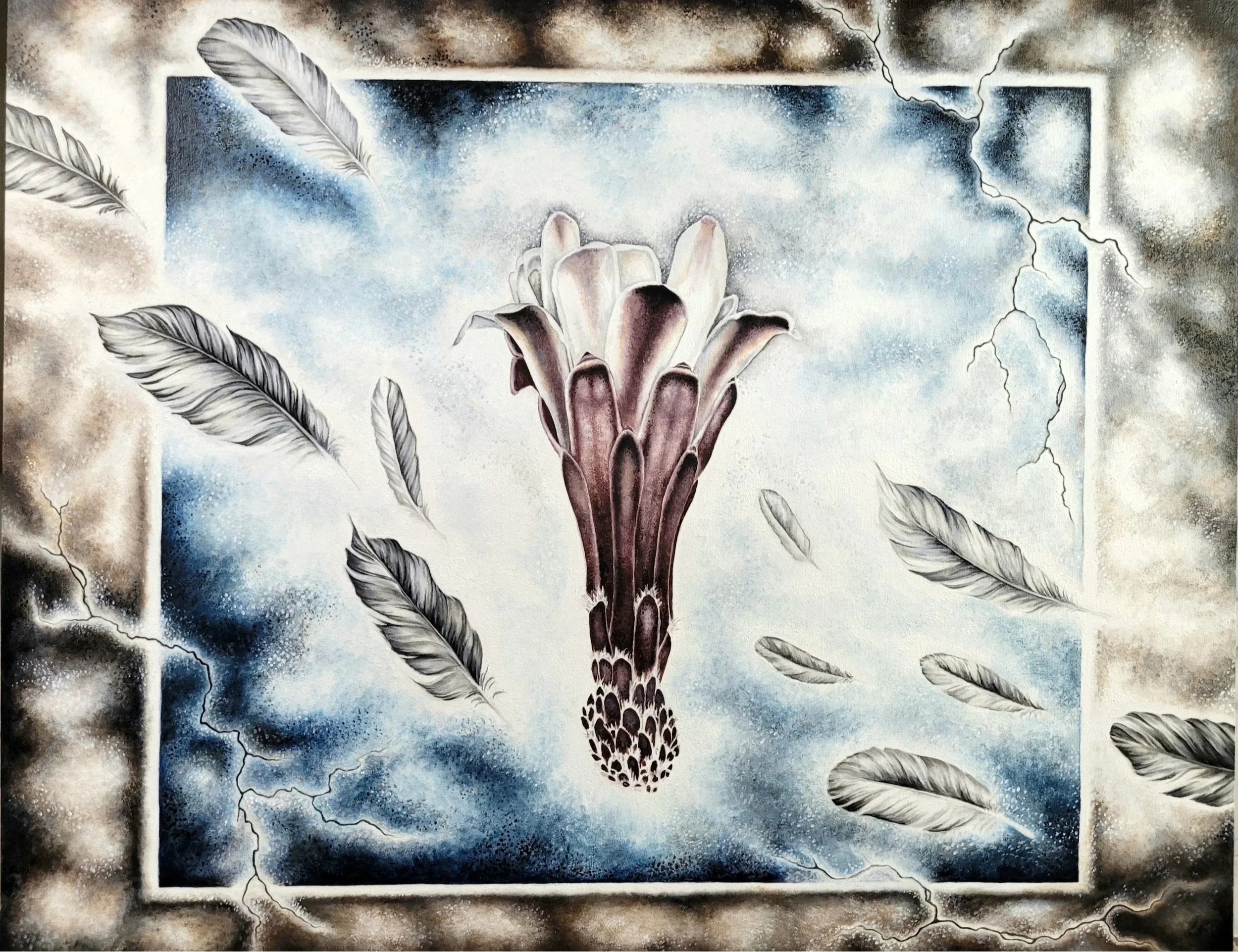
Silent Ascent
16”x20” Oil on Cradled Wood Panel
This painting, “Silent Ascent”, came to me in the most unconventional of ways. I was driven to create this composition after a cold chill passed through my bones on a hot summer day in the desert. While walking by my tallest cactus that morning, this stray, half- opened blossom fell at my feet, right amongst a handful of gray mourning dove feathers that were scattered before me. As I bent down to admire the flower, a hot breeze came seemingly out of nowhere and caried the feathers away. As that cold chill still ran through me, I was flooded with the heartfelt memories of my dearly departed son. I felt his presence - he was there with me. My heart felt heavy and light at the same time. He wasn’t just with me, he was actually part of me. I immediately needed to know what cactus blossoms and gray feathers represented. What I learned made my heart flutter.
Cactus blossoms are symbolic of several things, and according to some, they represent warm, enduring love that can withstand the test of time. They can symbolize maternal love, as well as spiritual growth. It is also believed that feathers have several meanings, and gray feathers specifically represent balance, knowledge, and wisdom. When they appear to be floating or drifting, they stand for the passage of time, or the transitioning of a spirit.
That hot, spring morning, I didn’t just come across a flower, I came across a higher understanding of the interconnectedness of all things. I was meant to walk by that cactus at that moment in time, the comfort I seek from the loss of my son can be found right before me at any given moment.
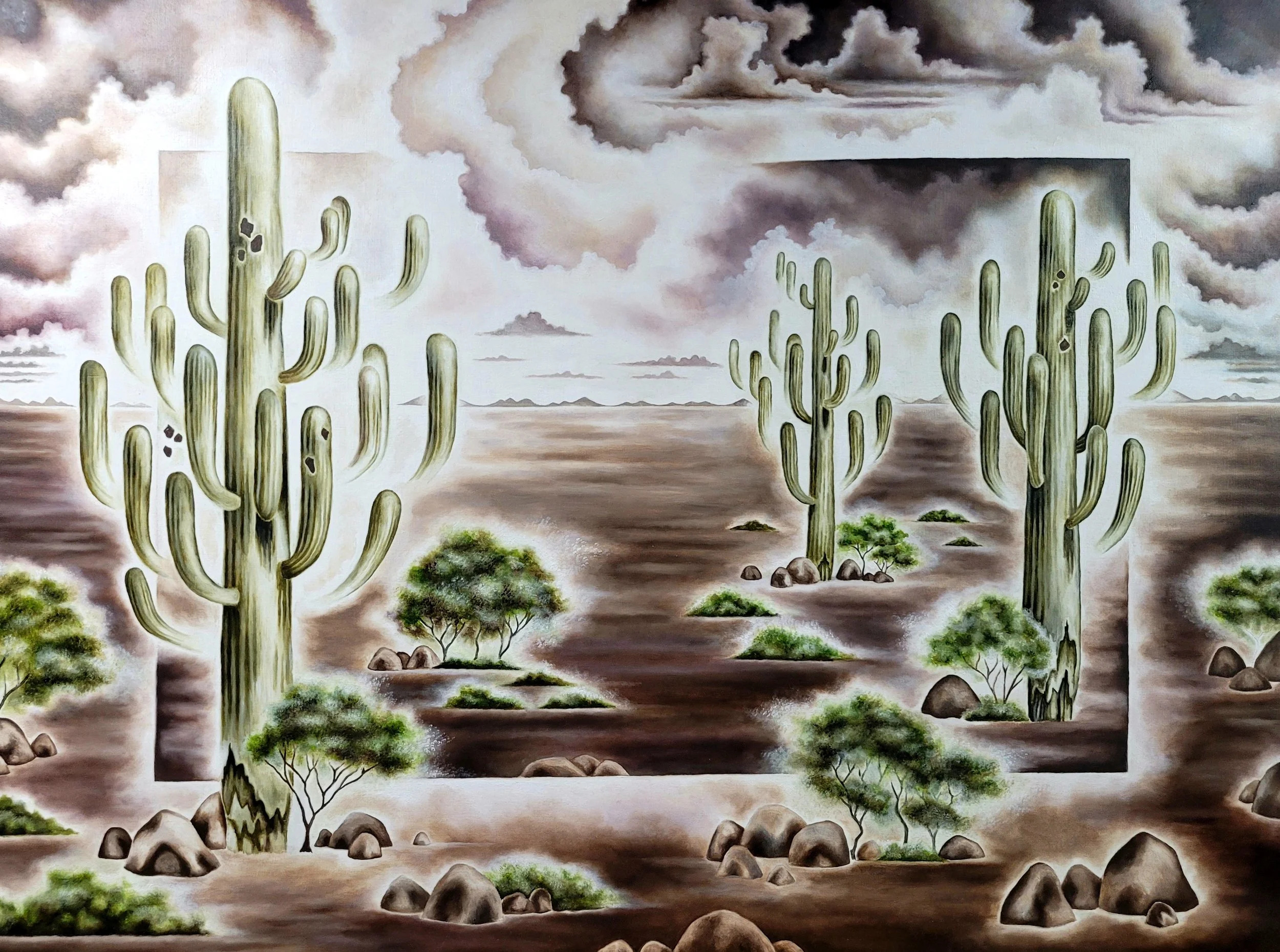
The number three has long carried a sense of spiritual significance, representing balance, unity, and the interconnectedness of existence. It can symbolize the past, present, and future; mind, body, and spirit; or the beginning, middle, and end of a journey. In this desert landscape, the presence of three towering saguaros invites contemplation of these connections. They stand as silent sentinels, seemingly solitary, yet bound together by the same earth, the same sky, and the same vast expanse of wilderness.
There is an irony in the desert's isolation. At first glance, it is a place of separation, where life appears scattered and alone, surrounded by seemingly endless stretches of emptiness. Yet the desert is anything but empty. Each cactus, tree, and stone occupies its own space, enduring independently while remaining part of a larger whole. The three saguaros become a quiet reminder that solitude does not necessarily mean disconnection. Perhaps the greatest paradox is that even in the most isolated places, there is an underlying sense of unity. Like the number three, which brings separate elements into a meaningful whole, the desert reveals that individuality and connection can coexist. We may stand alone in our own landscapes, but we are never entirely separate from the world around us.
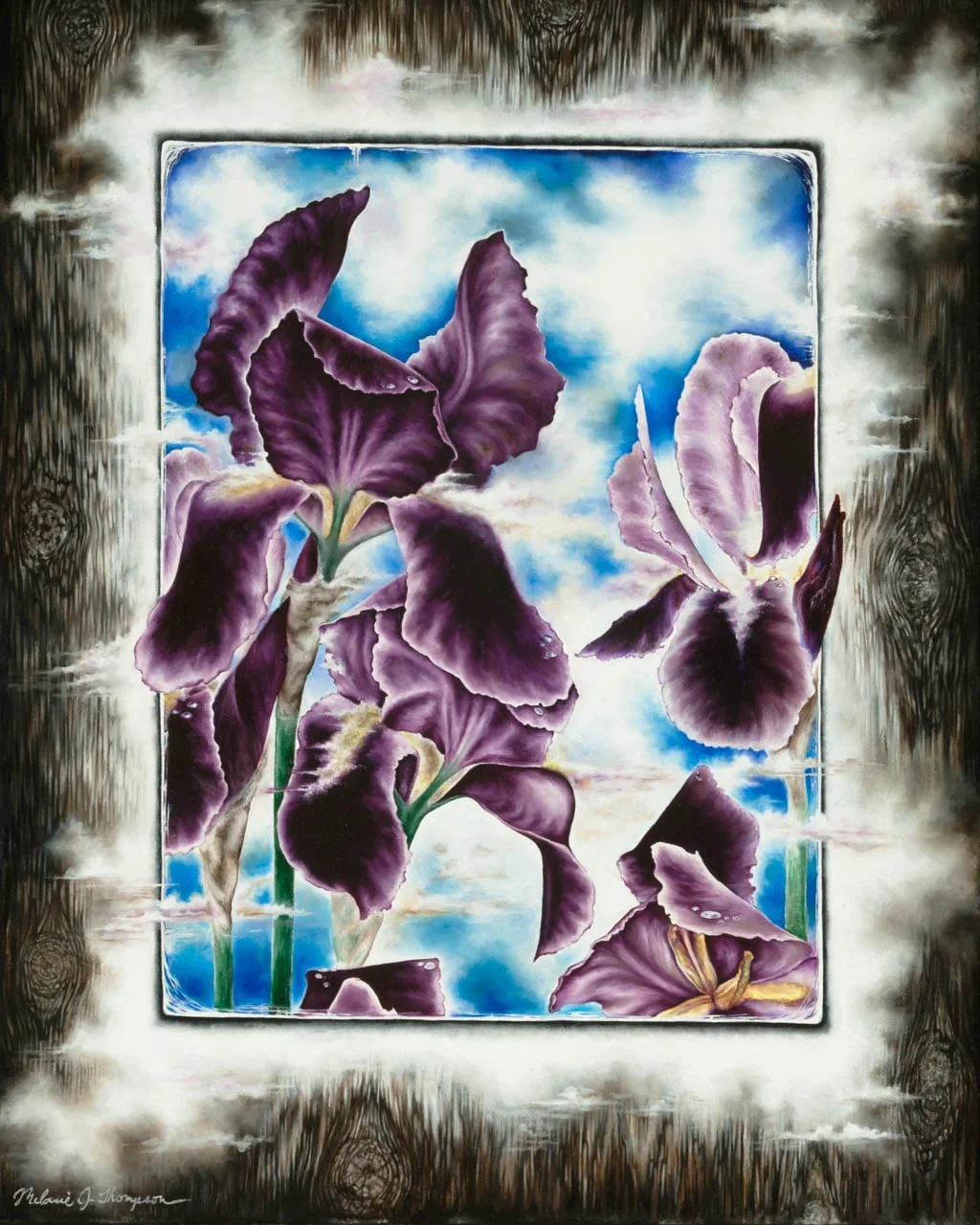
Lost in Translation
16”x20” Oil on Canvas
Memories have a way of changing as we revisit them, their details shifting and intertwining with the passage of time. Lost in Translation brings together two distinct recollections of irises: those that once grew in my mother's garden and others I remember from the red rock landscapes of Sedona. Though rooted in different places and moments in my life, they find themselves sharing the same space, suspended within a window that seems to open onto more than one memory.
The composition itself traveled a similar path. After numerous redrawings and revisions, the original image gradually transformed into som ething entirely its own, carrying echoes of what it once was while taking on a new identity. Perhaps this is how memory works, too. We attempt to preserve what we have seen and felt, yet with each recollection, something shifts, something fades, and something unexpected emerges. The hand-drawn woodgrain surrounding the flowers evokes the passage of time and the natural markings left behind by experience. Framed within a window, and then another, the irises become more than flowers. They become glimpses into the past, viewed through layers of perception, nostalgia, and personal history. What is lost in translation may never be fully recovered, but in its transformation, something beautiful can emerge.
Save this for my website